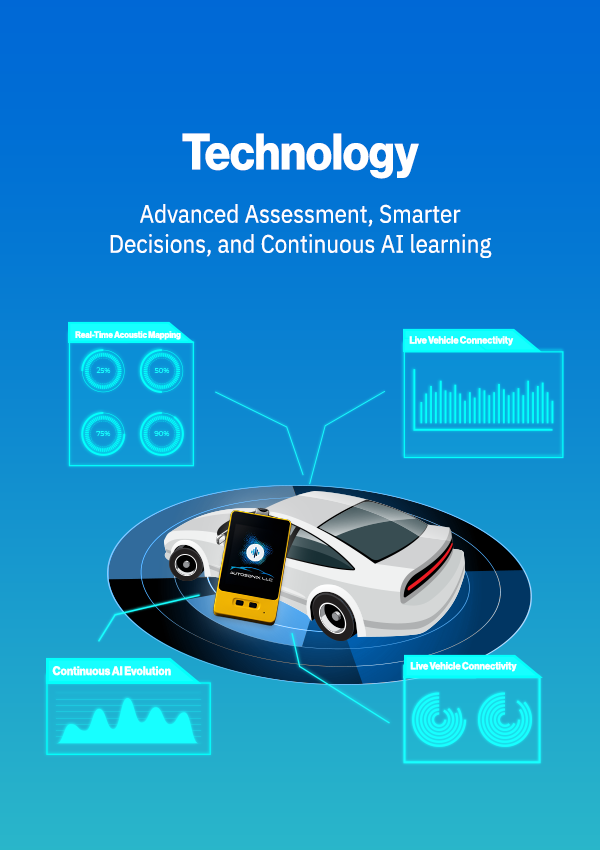
AI-Powered Technology Driving Automotive Innovation

PTX™ collects an acoustic signal at vehicle intake, combines it with traditional digital vehicle metrics then converts it into a standardized score objective, repeatable. It is not a diagnostic tool. It is a measurement standard, the mechanical signal the automotive industry has been missing at the intake moment.

The PTX™ score does not compare a vehicle to a database of known problems. It produces a standardized measurement the same way every time, regardless of make, model, mileage, or the person conducting the intake. That repeatability is what makes it a standard, not a tool.

The score is delivered to your team, and your downstream stakeholders without adding steps to your workflow. Built for scale. Built to run at intake speed.

Other attempts at mechanical sound worked by comparison. They measure a vehicle against a library of known sounds and look for deviation. That approach requires a reference point. It requires history. And it fails on any vehicle the library has not seen before. PTX™ does not work that way.

The AutoSonix model is trained to produce a standardized output directly from the signal, not from a comparison to something else. It does not need to have heard a 2019 F-150 before. It does not need a baseline from a matching vehicle. It collects the acoustic signal, combines it with OBD-II data, and converts both into a single standardized number using the same methodology, every time, regardless of make, model, mileage, or production year. That is what makes PTX™ scalable at intake speed. No lookup. No library. No prior record required.

The model is also designed to expand. Every PTX™ collection strengthens the underlying dataset. As the signal is collected across more vehicles, configurations, and operating conditions, the output becomes more consistent across edge cases and new models entering the market. The standard does not degrade over time. It compounds.

The Underlying Capability:
PTX™ is the result of combining signals: acoustic data collected at intake, OBD-II data where available, and the standardized output they produce together. But the foundation that makes PTX™ possible is a single, more fundamental capability: the ability to turn sound into a repeatable, objective metric. That capability is not limited to passenger vehicles. Anywhere a combustion engine operates, the acoustic signal can be collected, processed, and converted into a standardized score without a pre-existing library, without a matched baseline, and without OBD connectivity. The signal stands on its own as a measurement. The same methodology extends to electric motors. Electric drivetrains produce operational signals at frequencies outside the range of human perception. AutoSonix can be trained to collect and score those signals using the same standardized approach, producing a consistent metric from a source the industry has had no previous way to measure. One methodology. One output format. Any powertrain.

Core Technologies

Edge-Based Audio Analysis

Acoustic Signal Collection PTX™ captures an acoustic signal at intake using edge-based processing no internet dependency, no latency at the point of collection.

Live OBD-II Vehicle Connectivity

OBD-II Integration PTX™ integrates with OBD-II data to enrich the intake record giving downstream teams more context alongside the mechanical signal.

Cloud-Powered Dashboard

Cloud Signal Delivery The PTX™ score is delivered to a centralized dashboard the moment intake is complete accessible by your team at any location.

Continuous AI Learning

Expanding Signal Dataset Every PTX™ collection strengthens the underlying dataset. The signal becomes more consistent across new vehicle models and configurations over time.